1. Introduction to AI and LLMs
Already know this?
If you feel like you know this already, try your hand at the optional quiz and see how you do. Or you can just skip to the next section. We won’t judge you!
Introduction
Welcome to the first step on the road to understanding Generative AI and LLMs! This section provides a technical foundation for understanding how AI has evolved into today’s landscape of multimodal, reasoning-capable, and agentic systems – focusing on the architectural breakthroughs and implementation patterns that enable the frontier models built by OpenAI, Anthropic, Google, Meta, DeepSeek, Alibaba, and Mistral.
In 1950, Alan Turing opened his paper "Computing Machinery and Intelligence" with a profound question: “Can machines think?” He then set it aside as too ill-defined to answer, and proposed instead that we judge machines by what they can do – an instinct that turned out to be a good one. Today we’re building systems that process natural language, generate code, work through complex problems step by step, interpret images, and take autonomous action.
What will I get out of this?
By the end of this section, you will be able to:
- Explain the evolution of AI from rule-based systems through machine learning, deep learning, and Transformer-based architectures, into today’s era of multimodal, reasoning-capable, and agentic systems.
- Describe, in outline, how a Transformer-based LLM works – tokens, attention, and next-token prediction – and why that architecture was the breakthrough that made modern LLMs possible. (The mechanics are covered in depth in Section 4.)
- Identify the capabilities and limitations of Large Language Models (LLMs), including their applications across industries and the current landscape of model families.
- Understand the concept of prompts and their importance in guiding LLM outputs, including examples of effective and ineffective prompts.
- State why each of the five vulnerability classes resists a fix – prompt injection, jailbreaking, data poisoning, adversarial inputs and sensitive information disclosure – naming for each whether the defect sits in your application, in the provider’s model, or in the training data, since that decides who can remedy it.
- Explain why hallucination is an attack surface and not only a quality defect, using the consistency of fabrication rather than its frequency.
- Differentiate between AI errors (e.g., hallucinations vs. outdated data) and describe strategies for mitigating these issues in practical applications.
- Evaluate societal impacts of LLMs, discussing their transformative potential across industries while critically assessing ethical concerns like bias amplification, automation risks, and regulation challenges.
New Terminology Ahead
This section introduces a lot of vocabulary. Every term is defined where it first appears, and all of them are collected in the course Glossary if you want to look something up later or refresh your memory mid-course.
The Evolution of AI: A Technical Perspective
From Rules to Learning
Early AI systems relied on rigid, rule-based programming. For example, teaching a computer to recognize a cat required painstakingly writing rules like “If it has pointy ears and whiskers, it’s probably a cat.” However, this approach quickly fell short in handling real-world complexity. Intelligence isn’t about following static rules – it’s about learning and adapting.
Consider an early AI system designed to play chess. It would follow a set of predefined rules for each possible move. However, it couldn’t adapt to new strategies or learn from its mistakes, making it less effective against skilled human players.
The Machine Learning Breakthrough
The turning point came when researchers shifted from programming rules to teaching machines how to learn. Instead of manually coding every rule, they fed computers massive datasets – like millions of cat images – and let algorithms discover patterns on their own. This marked the birth of machine learning.
Instead of writing rules to identify spam emails, machine learning algorithms can be trained on a large dataset of emails labeled as spam or not spam, learning to identify spam based on patterns in the data.
The Neural Revolution
Deep learning took this further using neural networks – layers of interconnected nodes, loosely inspired by biological neurons, that pass signals forward through weighted connections. Each layer learns to detect increasingly abstract features: early layers might pick out edges in an image, later layers combine those into shapes, and later still into objects. The “deep” simply refers to having many such layers.
Voice assistants like Siri and Alexa use deep learning to understand and respond to spoken language, even with different accents and speech patterns.
A Useful Metaphor, Not a Description
You will often hear that neural networks “work like the human brain.” That analogy is where the name came from, but it is a loose one – artificial neurons are simple mathematical functions, and the resemblance to neuroscience is superficial. It is a helpful mental image; it is not a claim about how these systems actually think.
Each era is defined less by its date than by what stopped being hand-written. That is the through-line worth holding on to:
graph TB
    accTitle: The evolution of AI, from hand-written rules to agentic systems
    accDescr: Six eras in sequence. Rule-based systems, 1950s to 1980s, where humans write every rule. Machine learning, 1980s to 2000s, where the rules are learned from labelled data. Deep learning, 2010s, where the features are learned too, in layers. Transformers, 2017, where every token is weighed against every other. Large language models at scale, 2020s, where scale turns next-token prediction into general capability. And multimodal, reasoning and agentic systems from 2023 onward, where the model acts through real tools. Each step moves work from the human to the learned model, and the final step is what creates the attack surface this course addresses.

    A["<b>Rule-based systems</b><br/><small>1950s-1980s<br/>Humans write every rule</small>"]
    B["<b>Machine learning</b><br/><small>1980s-2000s<br/>The rules are learned<br/>from labelled data</small>"]
    C["<b>Deep learning</b><br/><small>2010s<br/>The features are learned<br/>too, layer by layer</small>"]
    D["<b>Transformers</b><br/><small>2017<br/>Every token weighed<br/>against every other</small>"]
    E["<b>LLMs at scale</b><br/><small>2020s<br/>Scale turns next-token<br/>prediction into<br/>general capability</small>"]
    F["<b>Multimodal, reasoning, agentic</b><br/><small>2023 onward<br/>The model acts:<br/>tools, steps, many modalities</small>"]

    A --> B --> C --> D --> E --> F

    style A fill:#4a4a4a,color:#fff
    style B fill:#1a3a5c,color:#fff
    style C fill:#1565c0,color:#fff
    style D fill:#1565c0,color:#fff
    style E fill:#1565c0,color:#fff
    style F fill:#a85800,color:#fff
Read the last box carefully, because the rest of this course lives there. Everything up to LLMs at scale describes a system that produces text. The moment a model also takes actions – calls a tool, reads a file, sends a request – the consequences of a wrong output stop being confined to the answer. Section 7 builds that shift properly, and it is the reason Chapter 2 has a whole section on agentic attack vectors.
A Language Leap: Transformers
In 2017, a paper with the memorable title "Attention Is All You Need" introduced the Transformer architecture, and it reshaped natural language processing. Transformers are exceptionally good at using context. Consider the word “bank” in these two sentences:
- “I walked along the bank and watched the current pull the leaves downstream.”
- “I walked into the bank and asked to speak to someone about a mortgage.”
Same word, entirely different meaning – and the only thing that distinguishes them is the surrounding text. Earlier architectures processed sentences one word at a time and struggled to carry that context. Transformers weigh every word against every other word at once, so “current” and “downstream” can pull “bank” toward one meaning while “mortgage” pulls it toward another.
How an LLM Actually Works, in Outline
Three ideas do most of the work. You will meet all of them properly in Section 4, but the outline matters now because almost everything else in this course builds on it.
-
Tokens. A model does not see letters or words. Text is first chopped into tokens – roughly word-sized pieces, though common words are usually a single token and unusual ones get split into several. “Unbelievable” might become
un+believ+able. Every input and every output is a sequence of these tokens. -
Attention. For each token, the model computes how much every other token in the context should influence it. This is the attention mechanism, and it is the Transformer’s central innovation. Because attention looks at the whole sequence simultaneously rather than walking through it in order, Transformers both capture long-range context far better than their predecessors and train efficiently on modern hardware.
-
Next-token prediction. Here is the part that surprises people. An LLM does exactly one thing: given the sequence of tokens so far, it predicts a probability distribution over what the next token should be. It picks one, appends it, and repeats. Sentence by sentence, essay by essay, an entire response is produced one token at a time.
This Is the Mental Model to Keep
Everything an LLM produces – an essay, a working program, a convincing lie – comes out of repeatedly answering “what token comes next?” There is no separate step where the model checks whether what it is saying is true. Hold onto this: it explains hallucinations later in this section, and it explains why prompt injection works in Chapter 2.
The Transformer is also what made Generative AI (GenAI) – systems that create new content such as text, images, audio, or code – work at scale for language. Generative models existed before 2017, but the Transformer, combined with enormous training datasets, is what turned generation from a research curiosity into something practically useful.
That combination produced the Large Language Models this course is about. They are strikingly capable: they hold context across long documents, connect ideas across domains, and produce fluent, useful output. Just keep in mind what is underneath – a very sophisticated engine for predicting the next token, not a mind that comprehends.
Today’s Landscape: Beyond Text Generation
The AI landscape has evolved dramatically beyond the early days of text-only chatbots. Today’s systems span several capabilities, each with different trade-offs. Note that these are not mutually exclusive categories – a single modern model is often multimodal and capable of extended reasoning and available in several sizes.
About the Model Names in This Course
Model examples on this page were verified in August 2026. The AI landscape moves fast. Model names below were verified at the date shown; the concepts they illustrate outlast any particular release. Always check a vendor's current documentation before making a deployment decision.
Processing multiple types of input and output
Frontier models now natively handle text, images, audio, video, and code within a single model. This isn’t just about bolting together separate systems – these models relate information across modalities.
For example, you can show a model a photograph of a whiteboard and ask it to turn the diagrams into working code, or hand it a chart image and ask it to describe the trend in words.
Named Model Examples
OpenAI's GPT-5.6 family (Sol, Terra, Luna), Anthropic's Claude Opus 5, Google's Gemini 3.1 Pro, and Meta's Muse Spark.
The concept of multimodality – processing different types of information together – is the important principle, regardless of which specific model you use.
Thinking before answering
Some tasks benefit from deliberation. Rather than answering immediately, a model can first generate an extended chain of intermediate reasoning – breaking a problem into steps, trying approaches, checking its own work – and only then produce the visible answer.
Mechanically, nothing new is happening: the model is still predicting one token at a time, exactly as described above. The difference is that many of those tokens are spent on private working-out rather than on the response. This is called test-time compute: letting a model spend more effort at the moment of answering buys better results on math, logic, coding, and multi-step analysis.
The trade-off is latency and cost. Reasoning consumes a lot of tokens, and you pay for them.
A Dial, Not a Species
This used to be a distinct product category – vendors shipped separate “reasoning models” alongside their normal ones. That distinction has largely dissolved. Reasoning is now typically an adjustable effort setting on a mainline model: you choose how hard it should think, per request. Expect to tune this knob rather than to pick a different model.
Named Model Examples
OpenAI's GPT-5.6 Sol at high reasoning effort, Anthropic's Claude Opus 5 with its effort dial, Google's Gemini 3.x thinking levels, and DeepSeek-V4 in thinking mode.
The durable concept is test-time compute, not any particular vendor’s name for the dial.
Powerful AI that runs on your device
Not all progress is about making bigger models. Small Language Models (SLMs) – typically in the 1B to 15B parameter range – are optimized to run on laptops, phones, and edge devices, often with no internet connection at all.
These models bring AI to privacy-sensitive environments, low-connectivity settings, and real-time applications where a round trip to a cloud API isn’t feasible. They have become genuinely capable, and on narrow, well-defined tasks a good small model will often hold its own against a much larger one – while costing a fraction as much to run.
That last point is the practical lesson: match the model to the task. Reaching for a frontier model to classify support tickets is an expensive habit.
Smaller is not safer, though, and the reasons are structural rather than incidental. SLMs tend to carry weaker safety training than frontier models; the compression that makes them fit a phone can degrade that training further; and a model on a device is a model whose weights an attacker with physical access already holds. The deployment property that makes them attractive here – no network round trip – is also what makes them invisible to every network-side discovery control you own. Chapter 2, Section 7 is dedicated to this.
Named Model Examples
Microsoft's Phi-4-mini (3.8B), Google's Gemini 3.5 Flash-Lite, Anthropic's Claude Haiku 4.5, and DeepSeek-V4-Flash.
The principle is that task-appropriate model sizing delivers good results at a fraction of the cost and latency.
Models you can download, run, and modify yourself
Alongside the API-only frontier models sits a thriving ecosystem of open-weight models – models whose trained parameters you can download and run on your own infrastructure. This has put capabilities once exclusive to large tech companies within reach of any organization willing to operate the hardware.
But the word “open” carries a lot of weight here, and it pays to be precise:
- Open weights means you can download and run the parameters. It does not usually mean you can see the training data, or the code and process that produced them.
- Licenses vary enormously. Some releases are genuinely permissive – Apache 2.0 or MIT, with no strings. Others are “community” licenses that look permissive but carry acceptable-use policies and commercial restrictions. Meta’s Llama license, for instance, caps free commercial use at 700 million monthly active users.
- Open weights are not permanent. In 2026 Meta – whose Llama series had been the backbone of the ecosystem – moved its frontier work to a proprietary successor. Building on an open-weight model is a bet on a vendor’s strategy as much as on its technology.
Named Model Examples
Alibaba's Qwen 3.x (Apache 2.0), DeepSeek-V4 (MIT), Mistral's open models (Apache 2.0), and Microsoft's Phi-4 family (MIT).
Note the licenses in parentheses. Always read the actual license before building on a model – “open” ranges from true Apache 2.0 to community terms with usage caps.
Read the License Before You Deploy
“Open source” is used loosely in AI marketing. For a deployment decision, the questions that matter are: can I run this commercially at my scale, can I fine-tune it, can I redistribute it, and what happens if the vendor changes direction? We explore these trade-offs in Deployment Considerations.
Capabilities and Limitations
Modern LLMs can assist in a remarkable range of tasks, including:
- Writing essays, code, and creative content
- Translating languages and summarizing reports
- Analyzing images, charts, and documents (multimodal capability)
- Reasoning through math, logic, and science problems (with reasoning effort turned up)
- Automating cybersecurity workflows such as analyzing threat reports or detecting phishing attempts
- Generating and debugging code across dozens of programming languages
Understanding Prompts: The Basic Building Block
At their core, LLMs work by responding to “prompts” – text inputs that tell the model what we want it to do. Think of a prompt as a conversation starter or instruction that guides the AI’s response. The way we phrase these prompts significantly impacts the quality and usefulness of the AI’s response. For example:
Change the framing and you change the output entirely:
Same topic, same model. The prompt did all the work.
A well-structured prompt typically includes:
- Clear instructions about what you want
- Relevant context or background information
- Any specific requirements for the format or style of the response
This careful crafting of prompts has evolved into its own discipline known as Prompt Engineering – both an art and a science that involves creating effective instructions for AI models. A skilled prompt engineer knows how to break down complex tasks into clear directives, provide the right context, and set appropriate constraints that guide the model toward producing accurate and useful responses.
Think of it This Way…
We’ll talk about Prompts and Prompt Engineering in more detail in another section ahead, but for now think of Prompts as instructions given to a very capable but very literal-minded assistant. The clearer and more specific your request, the better the response you’ll receive.
Limitations and Vulnerabilities
However, these models are not infallible. While they excel at generating human-like text, they also have critical limitations and vulnerabilities that must be understood for safe, responsible, and effective use. We’ll cover these in more extensive detail later in this course, but here is a quick overview:
Inherent limitations
These are properties of how LLMs work, not bugs to be patched:
- Knowledge cutoff: A model’s training data stops at a fixed date. Ask about anything after it and the model will either say it doesn’t know or, worse, confidently answer from stale knowledge. This is why the model roster in this very section carries a verification date.
- Context window limits: A model can only attend to a finite number of tokens at once. Exceed it and the earliest content falls out of view – the model doesn’t warn you, it simply loses the thread.
- Non-determinism: The same prompt can produce different outputs on different runs. This complicates testing, reproducibility, and incident investigation. Note that setting temperature to 0 does not remove it: inference batching makes the arithmetic depend on what else was running concurrently, so a replay is never guaranteed to be exact.
- No self-verification: As established earlier, the model predicts likely next tokens. Nothing in that process checks whether the output is true.
Biases
Models may reflect biases present in their training data, leading to unfair or inappropriate outputs. This kind of bias – output bias – is learned and distributed across the whole parameter set. It shares a name with the bias terms that Section 4 covers as part of a network’s arithmetic, and nothing else: output bias is not located in those numbers and cannot be audited through them.
Hallucinations and erroneous outputs
Models can generate content that appears convincing but has no basis in reality or their training data, and state it in a confident manner. This can be a serious issue in high-stakes applications, such as in agentic workflows where the model is used to make decisions and take actions, beyond just providing information.
Overreliance
A limitation of the system, not the model: because output is fluent and confident, people tend to under-scrutinize it. The failure mode is a human accepting a wrong answer they would have caught from a less articulate source. Measured rather than assumed – METR’s randomized trial found experienced developers were 19% slower with AI tooling while estimating they had been 20% faster. METR labels that result historical, having measured early-2025 tooling, so read the 39-point gap between measured and felt performance as the durable finding rather than the percentages.
The security reading is the one to carry forward: automation bias does not stay constant, it accumulates with every output that turns out to be fine. A reviewer who checked an agent’s first hundred actions is markedly less likely to check the hundred-and-first, which is why a good track record is an attack precondition rather than a reassurance – OWASP’s agentic list names it directly. Section 7 returns to it once agents can act, and sets out the METR evidence in both directions.
Vulnerabilities to Threats
- Prompt Injection: Crafted input that makes the model follow the attacker’s instructions instead of yours. It has no complete fix, because it exploits an architectural property rather than a coding error: everything assembled for a request arrives as one flat token sequence with no privilege levels, so an attacker’s text and your instructions carry equal weight. Chapter 2, Section 2 is built on this.
- Jailbreaking: Prompts that bypass safety alignment to get output the model was trained to refuse. Worth keeping apart from injection by whose instructions are subverted: injection defeats your application logic, which you can remedy; jailbreaking defeats the provider’s alignment, which you did not build and cannot patch.
- Data Poisoning: Corrupting what a model learns from, so the defect is baked into the weights and reaches every future interaction. Dilution is not a defence – the research measures a near-constant number of malicious documents rather than a percentage of the corpus, which is a quantity an attacker can produce.
- Adversarial Inputs: Inputs perturbed just far enough to cross a model’s decision boundary while looking unchanged to a human. The mathematics is identical for any differentiable model, which is the consequence to carry forward: your input filter is a model too, with a decision boundary and therefore adversarial examples of its own.
- Sensitive Information Disclosure: Confidential data reaching a user through model output. The route that gets most organisations needs no attacker at all – content your own retrieval pipeline fetched, passed straight through to a reader who was never entitled to see it.
These vulnerabilities highlight the importance of understanding not just what LLMs can do, but also where they fall short – and how they can be exploited. We’ll explore these threats in detail in Chapter 2, where we focus on LLM vulnerabilities, and again in Chapter 3 as we explore ways to mitigate risks.
Security Implications
It is key to always be aware of these limitations, since they are not just technical challenges; they also define the attack surface that cybersecurity solutions must look out for. From biased training data to adversarial inputs, understanding these foundational risks is essential for building secure AI systems.
Understanding AI Hallucinations
Hallucinations in AI represent a complex challenge that goes beyond simple mistakes or errors. They occur when an AI system generates content that appears convincing but has no basis in reality or its training data.
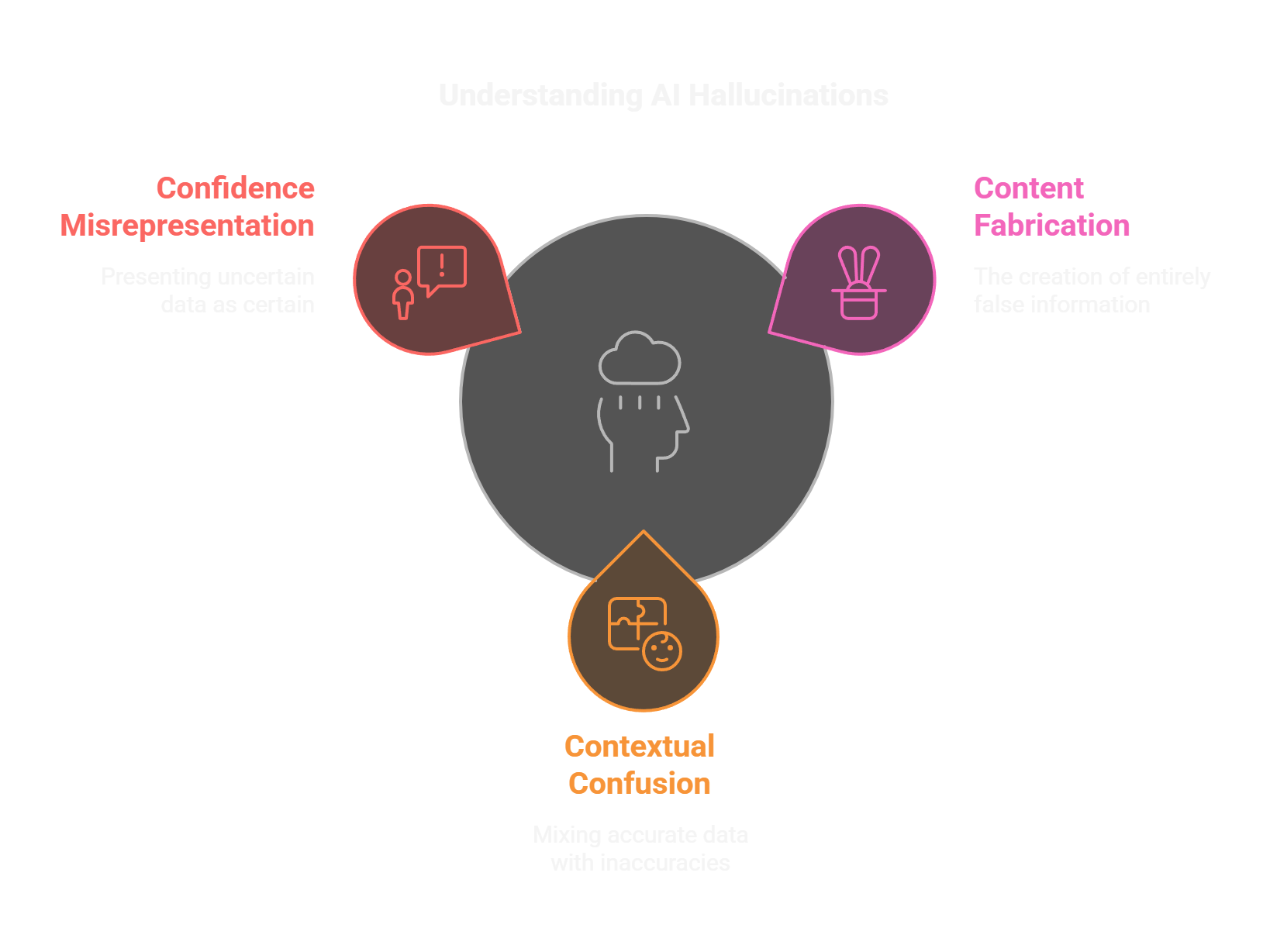
Types of Hallucinations
-
Content Fabrication:
- Complete invention of facts, figures, or narratives
- Generation of non-existent sources or references
- Creation of false relationships between real entities
-
Contextual Confusion:
- Mixing accurate information with false details
- Temporal inconsistencies (mixing up timelines)
- Inappropriate transfer of attributes between subjects
-
Confidence Misrepresentation:
- Presenting speculative information as factual
- Maintaining false certainty despite contradictory evidence
- Generating precise but incorrect details
Hallucination is an attack surface, not only a quality problem
Everything above frames hallucination as something that degrades an answer. It is also something an attacker can aim, and the property that makes that possible is the one you would expect to be harmless: fabrication is consistent. Models do not invent a fresh wrong name each time – they invent the same wrong name repeatedly, and consistently enough across different models that the fabrication can be predicted and pre-registered.
That converts a correctness defect into a supply-chain one. Register the package, domain or command that models reliably hallucinate, and wait to be recommended. Chapter 2, Section 6 works this through as slopsquatting with the measured numbers, and it is why “use a better model” is not a defence: the convergence between models is the attack, not a weakness of any one of them.
Carry two readings of consistency, then. For answer quality it means a wrong answer arrives repeatably. For security it means a wrong answer arrives predictably – and predictable is what an attacker needs.
Important Distinction!
While it is a catchy term that is being used ubiquitously, not every AI error is a hallucination! There are other types of errors that can emerge from LLM use that are not hallucinations. The key differences include:
| True Hallucinations | Other AI Errors |
|---|---|
| Generated content has no basis in training data | Outdated information from training data |
| Cannot be traced to any legitimate source | Misunderstandings of context or instructions |
| Often highly specific and detailed | Processing or formatting mistakes |
Why This Distinction Matters
Understanding the difference helps choose the right solution:
- Hallucinations: Reduced most effectively by grounding – giving the model authoritative source material to work from and requiring it to cite that source. This is the core idea behind Retrieval-Augmented Generation (RAG), covered in Section 6. Note that grounding buys plausibility, not correctness: a grounded answer built on an outdated or poisoned passage arrives with a citation attached, which raises the reader’s confidence without raising the answer’s accuracy. Next best is external verification of claims, then prompting the model to flag its own uncertainty. Sampling parameters like temperature are the weakest lever here: lowering temperature makes output more predictable, but a confidently wrong answer delivered consistently is not an improvement.
- Training Data Errors: Fixed by updating or cleaning the training dataset, or by grounding the model in current data at inference time.
- Ambiguous Outputs: Improved through better prompt engineering.
In short, not all AI errors are hallucinations, and mitigation strategies vary by error type.
What impact are LLMs having on industries and modern society?
Imagine a world where your doctor consults not just their years of medical training but also an AI assistant that has analyzed millions of medical studies in seconds. Picture a classroom where every student has access to a personalized tutor who adapts to their learning pace, or a newsroom where journalists collaborate with AI to fact-check stories in real time. These scenarios are no longer distant dreams – they are already in production, powered by the rapid adoption of Large Language Models.
Transforming Industries
Across industries, LLMs are acting as catalysts for innovation. In healthcare, for instance, clinicians use them to draft discharge summaries, condense a patient’s history into a briefing before an appointment, and synthesize findings across thousands of published studies – work that is language-heavy and enormously time-consuming. But this isn’t without risks: what happens when a summary confidently states a medication the patient was never prescribed? The stakes are high, and so is the potential.
Keep the Hierarchy Straight
Healthcare AI is often discussed as one thing, but it isn’t. An AI system that flags anomalies in an X-ray is a computer vision model – deep learning, but not an LLM. An AI that drafts the radiologist’s report from their notes is an LLM. Both are AI; only one is the subject of this course. That distinction (AI ⊃ machine learning ⊃ deep learning ⊃ LLMs) matters when you are assessing risk, because the two fail in completely different ways.
Education
Education is another domain undergoing seismic shifts. Teachers now have tools that can summarize complex topics, generate lesson plans, or even provide instant feedback on student essays. Yet, there’s an ongoing debate: Will students become overly reliant on AI, losing the ability to think critically? Educators must strike a balance between leveraging these tools and fostering independent thought.
Creative Industries
In the creative industries, LLMs are both a boon and a challenge. They can draft marketing copy, write scripts, or even compose music. However, questions about originality and intellectual property loom large. Is a song co-written by an AI truly creative? And who owns the rights to it – the user or the developer of the model?
Cybersecurity
Even cybersecurity professionals are finding new allies in LLMs. These models can analyze threat reports or triage phishing attempts at scale. But ironically, they also introduce new vulnerabilities: adversarial inputs can manipulate outputs, and attackers use models to lower the effort involved in social engineering – producing fluent, well-targeted phishing in languages they don’t speak, or iterating on malware variants faster than they could by hand. Frontier providers do apply safety measures against the most direct forms of this abuse, but open-weight models can be fine-tuned to remove them.
Shaping Society
Beyond individual industries, LLMs are reshaping societal structures in profound ways. Automation is one of the most contentious issues. As repetitive tasks are handed over to AI – whether it’s customer service chatbots or data entry systems – significant numbers of existing roles are exposed to displacement, though credible estimates of the scale vary widely and should be treated with caution. Yet history shows that technological revolutions often create new opportunities. The rise of AI has already spurred demand for roles in model development, ethical oversight, and AI governance.
Bias amplification
Bias amplification is another critical issue. LLMs trained on biased datasets risk perpetuating societal inequalities. For example, an AI used in hiring could favor certain demographics if its training data reflects historical biases. The challenge lies in designing systems that not only reflect but also improve upon human fairness.
Ethical concerns
Ethical concerns extend beyond bias. Hallucinations – a hallmark limitation of LLMs – pose risks in high-stakes applications like legal advice or medical recommendations. Imagine an AI confidently citing non-existent laws or recommending harmful treatments; the consequences could be catastrophic.
Regulation and Public Perception
Regulation is emerging as a key area of focus. Governments worldwide are grappling with how to govern these powerful tools without stifling innovation.
The European Union’s AI Act is the most developed example. It entered into force on 1 August 2024 and applies in stages rather than all at once:
| Date | What applies |
|---|---|
| 2 February 2025 | Prohibited AI practices; AI-literacy obligations |
| 2 August 2025 | Obligations for general-purpose AI (GPAI) models; governance rules; penalties |
| 2 August 2026 | The Act becomes generally applicable, including high-risk system obligations |
| 2 August 2027 | Remaining high-risk categories; deadline for pre-existing GPAI models to comply |
The Act classifies systems by risk level – from minimal risk through high risk to outright prohibited practices – and scales obligations accordingly. The GPAI provisions are the ones that bind the model providers discussed in this chapter, covering transparency, documentation, and systemic-risk assessment.
Elsewhere the picture is uneven. China already has binding rules in force, including measures governing generative AI services and filing requirements for algorithms and deep synthesis. The United States has no comprehensive federal AI statute; it operates through executive action, sector-specific regulators, and a growing patchwork of state laws. We return to governance and compliance in Chapter 3.
The public’s perception of AI oscillates between awe and fear. On one hand, there’s excitement about its potential to solve humanity’s biggest challenges – from climate modeling to disease eradication. On the other hand, misconceptions about “sentient” machines fuel dystopian fears.
Transparency will be crucial in building trust. Users need to understand not just what these models can do but also their limitations – why they sometimes hallucinate or fail spectacularly at tasks humans find trivial.
The Road Ahead
As we stand at this crossroads, one thing is clear: LLMs are not just tools; they are mirrors reflecting our own ingenuity and flaws. Their impact will depend on how responsibly we wield them – balancing innovation with ethics, efficiency with fairness, and automation with humanity.
Key Takeaways
- AI has evolved from rigid rule-based systems through machine learning and deep learning to today’s Transformer-based Large Language Models
- An LLM does one thing: predict the next token, over and over. Tokens, attention, and next-token prediction are the three ideas underneath everything else in this course
- Nothing in that process verifies truth – which is precisely why hallucinations happen, and why prompt injection works
- Today’s landscape spans multimodal capability, adjustable reasoning effort, small on-device models, and a substantial open-weight ecosystem – but “open” covers a wide range of licenses, so read them before you build. smaller is not safer: an on-device model carries weaker safety training and hands its weights to anyone holding the device
- Prompt engineering – crafting clear, specific instructions – is the primary interface for guiding LLM outputs effectively
- Ask who owns the fix for each vulnerability class. Prompt injection is architectural and has no complete fix; jailbreaking defeats the provider’s alignment, which you cannot patch; poisoning is in the weights; and the commonest disclosure route is your own retrieval pipeline, with no attacker involved at all
- Consistency is what makes a defect weaponizable. A model that fabricates the same name every time is a model whose fabrication can be pre-registered – which turns hallucination from a quality problem into a supply-chain one, and is why your input filter, being a model itself, has adversarial examples too
Test Your Knowledge
Ready to test your understanding of AI fundamentals and LLMs? Head to the quiz to check your knowledge.
Up next
Now that we’ve explored how AI has evolved into today’s powerful LLMs – from rule-based systems through next-token prediction, reasoning effort, and the open-weight ecosystem – it’s time to look at the industry as it is right now. The big players and their models, their similarities, differences, and respective strengths.